About Me

An Economics and International Studies student on a journey to Morocco to learn about Islam, myself, and life.
Showing posts with label Religion. Show all posts

Wednesday, November 16, 2011

Al-Eid Mubarak!


For those who don’t follow the Muslim calendar of festivals, Eid al-Kabir (the big celebration) was on Monday November 7; but just like for Christmas, there was much to do before the big day.  The goal of this blog entry is to how much effort goes into this annual sacrifice that only lasts a few minutes, but takes days to prepare.  So without further adieu, here is the countdown to Eid Al-Kabir.

4 Days utill Eid (Thursday Nov. 3): Mama Nezha went out to a souk on the outskirts of Rabat and bought our sheep along with a sheep for her daughter Omnia’s family and for her sister Merriam’s family.  When I got home that night after teaching English, Amine, my host brother, took down into the basement of the apartment building to show me our sheep.  I think we were the first in the apartment building to have gotten our sheep, because that night there were only 3 sheep in the medium-sized storage closet, but on Eid at least 5 or 6 sheep came out of that room, one at a time to be sacrificed.

No, this isn't a sign of the Apocalypse; it's just
a few young Moroccans burning off the hair
of sheep heads in the middle of the street the day after Eid.
3 Days utill Eid (Friday Nov. 4): I drove up to Tangier with my program for the weekend to see the northern part of Morocco, which was under the Spanish protectorate, not the French.  The Eid preparations weren’t very visible in the modern part of the city, which the Europeans had built while the city still had its international status before Morocco gained independence in 1956, largely because it was raining.  As a side note on Tangier, my first impression of the city was underwhelming – it felt like the city was inhabited by “foreigners” (i.e. Moroccans) trying to find a new identity after the “native” builders of the city (i.e. Europeans) fled once Morocco gained control of the city.

2 Days utill Eid (Saturday Nov. 5): Once I actually walked around in the Medina (the old Moroccan part of the city) I finally saw all the sheep and hay bales I was expecting to find.  You could feel the excitement in the air as everyone was busy buying their sheep, sharpening their knifes, and acquiring their charcoal for the big feast.  The most memorable example was watching a group of young Moroccan kids going crazy over a sheep someone had just bought – some were helping to push it (since sheep can be very obstinate when they’re 1) by themselves and 2) about to be killed) while others were busy pointing out to us the sheep that was obviously there.  But the Eid madness didn’t end there.  Later that day we set off for Chefchaouen, a town tucked away in the Rif Mountains southeast of Tangier, and sat in a virtual parking lot for 2 hours in Tetouan because of the huge sheep market that was being held.  So as we sat in our bus inching forward, both on and sometimes off the road, a steady stream of people with newly purchased goats and sheep trickled past us; a few of the sheep willingly went along, but most of them had to be pushed, pulled, yanked, or even carried.  Finally, after a 6 hour bus ride that should only have taken 4 we made it to Chefchaouen, which means “Look! Two horns” for the horn-shaped mountain range the town’s built around.   
Eid dinner: sheep stomach tajine with several side salads, olives,
and of course, bread

1 Day until Eid (Sunday Nov. 6): Unsurprisingly, Eid preparations were also occurring in Chefchaouen – there; there were so many sheep and so much hay all over the medina that one couldn’t go five steps witout running into some reminder of the approaching Eid.  The strangest reminder of Eid in Chefchaouen was listening to an imam preach the story of Eid al-Kabir (in English) on the steps of a nearby mosque while I and afew friends ate lunch.  His enthusiasm of trying to include foreigners in the Eid without hesitation was a theme that was also present in my host family when I got home that night after another 6 hour bus ride delayed by village sheep markets.  The moment my host mom opened the door to our apartment that night, the excitement of the approaching Eid washed over me.  It was the same feeling of the night before Thanksgiving and Christmas of anxious anticipation for the holiday to start, and the feeling was so familiar that for a few hours I almost felt like I was back home celebrating Christmas with my family in Minnesota – the oven was busy baking bread, the stove was sizzling with beghrir (Moroccan pancakes) for breakfast the next day, and the kids (Hussam [6] and Yassine [1.5]) were running around telling me how we were going to kill the sheep tomorrow morning.  Then at around 11pm everyone went to bed so we could get up early to get a head start on the Eid festivities.


Al-Eid Mubarak! (Monday Nov. 7): The big day started bright and early at 7am with breakfast and my family’s morning prayers.  Breakfast was bigger than usual because family is so important in Morocco, especially during Eid, that my host sister, her husband, Yassine, and Hussam had spent the night (and would stay 3 more nights after that) even though they lived in the neighborhood next to us.  Then at about 9am the first sheep was dragged into the courtyard, its throat was cut, its skin was removed before I even realized it had started.  Thankfully for me our sheep was only the first of 8 to be sacrificed in the courtyard.  As the morning dragged on, the other families from the apartment slowly trickled out into the courtyard to kill their sheep and help out everyone else kill and clean the sheep and their innards.  The rest of the day continued at a leisurely Christmas Day pace, with liver and heart brochettes for lunch and 2 huge sheep stomach tajines for dinner at my host aunt’s house.  If you can get over the strange foods and the smell of dead sheep and blood, Eid truly is a wonderful holiday.



Wednesday, October 12, 2011

The Rihla of an American College Student


Today in Contemporary Moroccan History, we talked about a genre of Moroccan travel literature called rihla, which was first used developed by Moroccans to try to write about and share the knowledge they gained while on the Pilgrimage to Mecca and Medina, and later used by Moroccan diplomatic envoys to Europe to describe their experiences in the foreign Christian world.  I won’t bore everyone with the details the rihla writers, but I bring it up because I realized in class that I am experiencing what the Moroccan envoys to Europe experienced 300 years ago – going to a foreign land, with a foreign language and foreign customs and trying to share the experience so that others may share in the knowledge gained from it.  But instead of writing as a Moroccan official concerned with using diplomacy to preserve Morocco’s sovereignty, I’m writing as a poor (although relatively rich by Moroccan standards) college student focused on broadening my understanding of humanity to make my corner of the world a more interesting place.  One of the characteristics of almost all travel literature is comparing where one came from with where one is, so I’ll give it a shot too.   
Over the last week I’ve noticed that the average Moroccan seems to know as much about Christianity as the average American seems to know about Islam.  For instance, one night I met with two of my Moroccan friends, Hamid and Imid, and we eventually got to the topic of alcohol.  I said that I only drink wine at church, which only elicited quizzical looks from Hamid and Imid.  I then tried to explain the concept of Communion to them, but in the end just gave up because it was clear that trying to explain the theological significance of Communion was only making them more confused.  The cross-cultural miscommunication was so bad that I think I’ve convinced two Moroccans that Christians only get together to get drunk on wine and cannibalize the body of Jesus (which is kind of embarrassing since I was the president of the Interfaith Council last year, whose sole purpose is to try to avoid this type of mishap).  However, considering that there are only 25,000 Christians out of 30 million Moroccans, and almost all of them are foreigners from outside Morocco (either from Europe or the rest of Africa), I can understand why the tenants of Christianity are not widely known throughout Morocco.
I’ve also noticed that there is a huge division between what is public and what is private in Morocco.  For instance, when my host mom, Nezha, goes out of the house, she wears a hijab, but when she’s at home among family she takes it off and relaxes inside the private space of the home.  Similarly, windows are smaller in Morocco and are often shut to try to physically separate the private realm of the household from the public realm of everyone else.  With this in mind, I know that I’ve been shoved into the mama Nezha’s family and accepted as one of her own sons because last Friday I invited one of my friends over to have couscous at our house since his host parents both work during the day and can’t prepare the traditional Friday couscous lunch.  Mama Nezha’s mom, Hajja Betu, happened to be staying with us for a few days while she waited to see a doctor, and when my friend and I walked in, she quickly covered her hair before we gathered together to eat.  Hajja Betu has never covered her hair around me (except when she was praying, of course), so this experience was a striking example of the division between public (e.g. my friend) and private (e.g. the family).
Finally, on a lighter note, Yassine, my one year old host nephew, almost knows my name, despite the fact that I dropped him the last time I saw him while bouncing him on my leg.  In many ways, I feel a lot like Yassine right now, because he is just learning to speak and tries to parrot every word that someone says, which is exactly what I do when mama Nezha tells me a new word for something in Darija.  Mama Nezha has also been telling me that it’s getting cold out, which I guess is technically correct since the mid-70’s is cooler than the mid-80’s, but it still feels like summer.  Some people would love having summer 24/7, but not me.  Right now I am craving Fall and would give anything to be transported to southeastern Minnesota to see the colors on the trees just for a few minutes.

Wednesday, October 5, 2011

Christian in a Muslim World


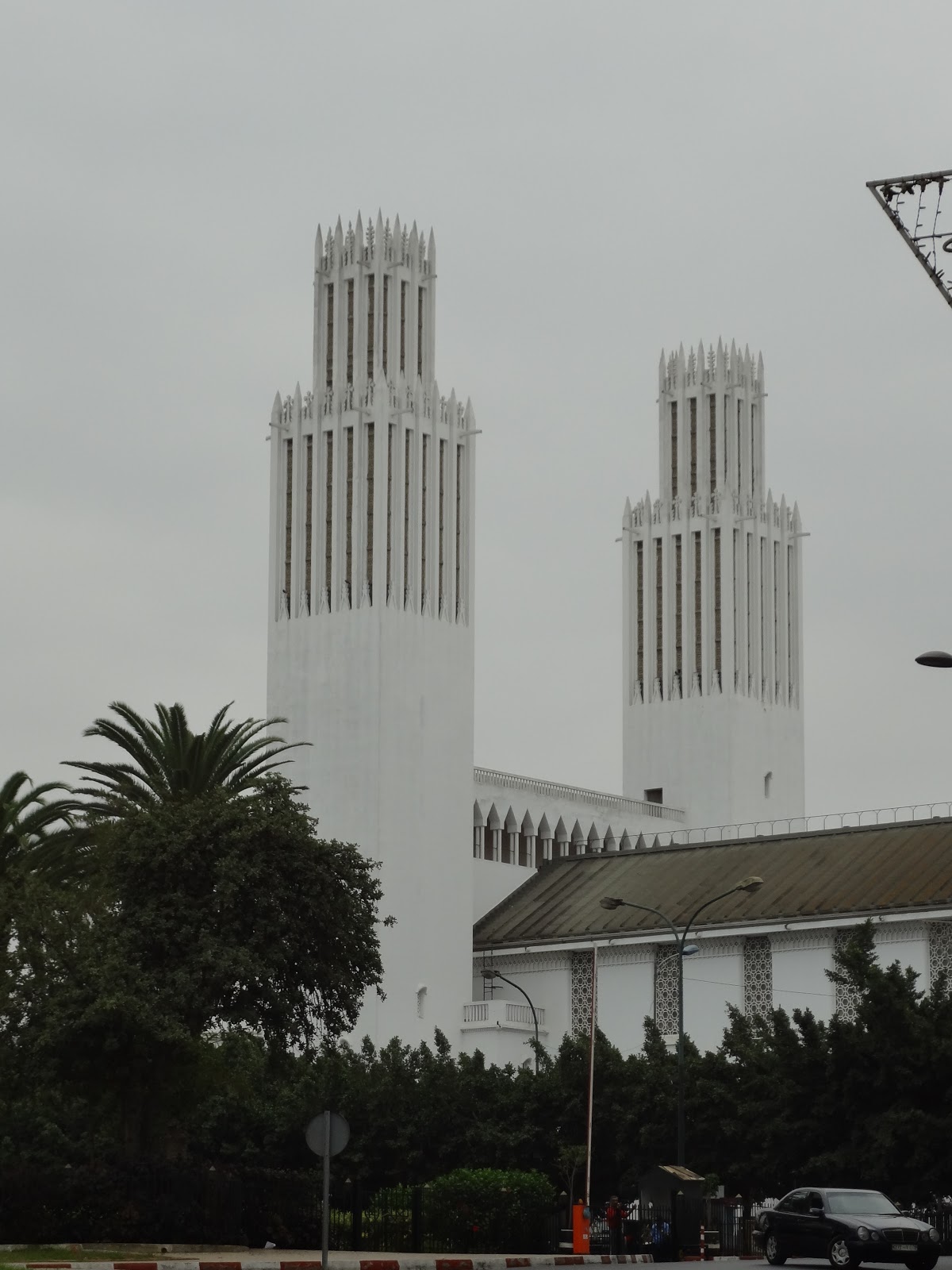
Cathédrale Saint-Pierre


I’ve often heard that Islam is not a religion, but a way of life.  I think that after only a month in Morocco, I’m beginning to understand why.  The way Moroccans greet each other, interact with each other, and say good-bye to each other is infused with and inseparable from Islam.  For instance, every time Moroccans great one another, they ask “Labas?” (How are you?), and respond with “Labas, lhmdo lilah” (Fine, thanks be to God).  When I’m with my host mom, it feels like she says “lhmdo lilah” every other sentence – when she’s done eating, drinks a glass of water, finds out someone else is doing okay, etc… 
            Society in Morocco, like all other Muslim countries, is also punctuated by the call to prayer that’s broadcast from all the mosques in the city to remind everyone of the five daily prayers that all Muslims are supposed to pray.  I thought the call to prayer would have a more commanding presence than I’ve found it to have; part of the reason may be that I don’t live or have classes close to a mosque, so I often only hear the call to prayer as a distant song.  Some nights at about 4:30am I do hear it, but it seems more like a dream than reality.  Another weakness of the call to prayer is that the mosques are often out of sync with each other, so just as one mosque finishes another will begin.  But probably the main reason is that I almost never see Moroccans responding to the call to prayer – while being reminded to pray, most Moroccans just keep on with whatever they’re doing.  There are some who make their way to the mosque to pray or get down on a rug or piece of cardboard on the sidewalk, but these people are often older men.
            The above commentary in one way is meant to suggest that Moroccans aren’t good Muslims (that’s not for me to judge) or never prayer (although I’m sure there are a substantial number of Moroccans who don’t pray, especially younger, westernized Moroccans like my host brother).  My host mom still does her daily prayers on the carpet in the fancy sitting room, but she does them at her own time.  This seems to be a general, almost paradoxical theme in Morocco – Islam is everywhere and absolute, but it is not rigid (although that could change if Moroccans aren’t careful). 
I’m probably exaggerating quite a lot and much of what I'm saying probably isn't true, but the Islam Morocco has now appears to me, the outsider, to be a living religion, which Christian churches in the US would give anything to achieve.  I’m not claiming that everything is perfect in Morocco, but the poor on the street are almost always fed, either a few dirhams or a bag of food from people passing by (I saw one man buy a bag of prickly fruit from a fruit cart and turn right around and hand it to an old woman and her grandchild).  There are still many unsolved social problems, but at least people are treated like people, and not like they don't exist.  In general, the main difference between religion the US and Morocco is that Moroccans know they have problems and try to fix them despite their limited resources, whereas the Church in America has the resources to solve its social problems but doesn't have the drive to try.
Living in a Muslim country for the four weeks has been interesting as a Christian.  I haven’t been able to find a Protestant church in Rabat, so I’ve been going to the Cathedrale Saint-Pierre.  Even though it’s mass and it’s in French, I still feel like I’m being transported by home from the moment I step into the cathedral to the moment I leave.  The congregation is probably 90% African with the other 10% Europeans and always seems to be on the verge of dancing during all the hymns, which are lead by an angelic choir of African women.  I can follow most of the service, and even if I can’t follow exactly what’s going on, I use the time for reflection and meditation and my own prayers.  The hardest part is not being able to partake in Communion, which I haven’t had in over five weeks.  I just have to keep reminding myself that I wanted to come to Morocco and be part of a minority of 25,000 Christians.